Listen to this page
Press play to listen.
The recording could not be played. Please try again later.
Why does manual translation require care?
A user manual is the sole official text explaining how to use a product correctly and safely. A mistranslated assembly step or safety warning can result in product damage, warranty disputes and, in the worst case, injury to the user.
The manual is also the brand's voice to the user. A manual translated into poorly formed sentences gives an impression of carelessness, however good the product may be; for corporate buyers, translation quality is a direct criterion in evaluating a supplier.
Turkish for imports, the target language for exports
Consumer legislation explicitly requires products offered for sale in Türkiye to have a Turkish introduction and user manual. An imported product cannot be placed on the market before its foreign-language manual has been translated into Turkish.
For exports, the direction is reversed: in the European Union market, many product groups require the manual to be provided in the official language of the member state where the product is sold. Selling across Europe with a single English manual is not possible for most product groups; a separate language version is prepared for each market.
This requirement in both directions makes manual translation a prerequisite for sales rather than a marketing preference.
Terminology consistency: the backbone of technical translation
Referring to the same part by one name on one page of a manual and another name on another page is the most common translation defect that misleads users. In a quality process, a terminology list (glossary) is created before translation begins, and each term is assigned a single equivalent.
- Part and component names must match the product's interface and labels exactly; a button labelled "Start" on the screen should not be given a different name in the manual
- Warning levels are expressed using the target language's established wording; danger, warning and caution levels are not confused with one another
- Units of measurement are shown according to the target market's system; where necessary, both units are written together
- Repeated sentences are translated consistently using translation memory to maintain consistency throughout the document
Formatting, visuals and page layout
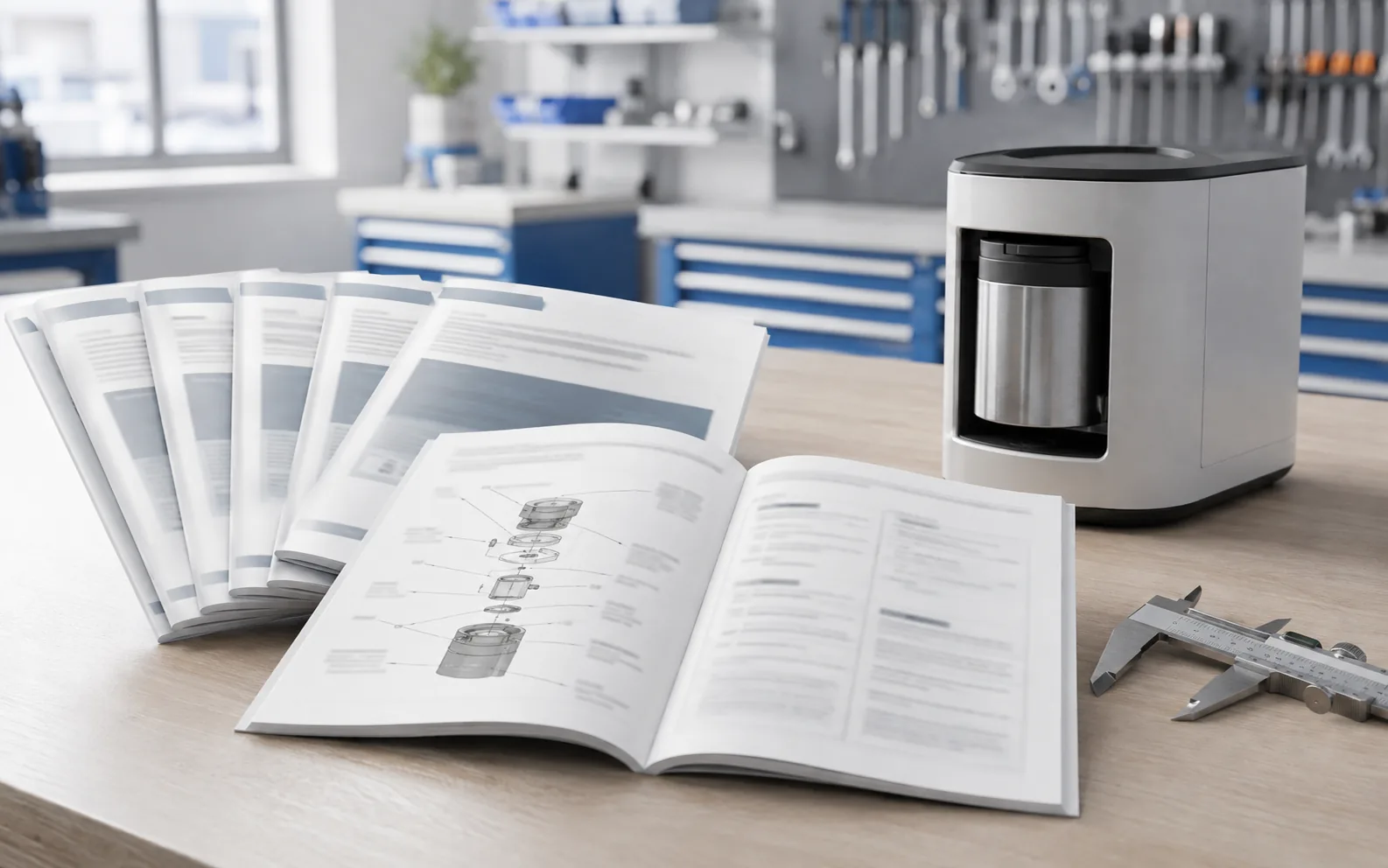
Manual translation does not end with the text. Diagram labels, table headings, explanations of safety pictograms and the index are transferred into the target language within the same layout. As text expansion after translation can disrupt page layout, the final document is also checked visually before delivery.
The source file format affects the process: if an editable Word or InDesign file is available, translation proceeds directly within the layout; if only a PDF or printed copy is available, the text is extracted first and the layout is reconstructed after translation. Specifying the source file format at the quotation stage makes the turnaround estimate clearer.
The process: translation, checking and proofreading
A single pair of eyes is not enough for technical translation. Translation is followed by a second review by someone familiar with the field's terminology; technical information such as numbers, model names, torque and temperature values is compared with the source. Where possible, final proofreading is carried out alongside the product itself or its interface to verify that the steps in the manual actually work on the device in that order.
Raw machine translation is not suitable for publication in technical texts; it does not reliably establish consistent terminology and warning wording. Technology can improve speed, but any text to be published must always be checked by an expert translator.
Frequently asked questions
How is the price of manual translation determined?
Word volume, technical complexity, the language pair and the file format are the main criteria. As manuals have high levels of repetition, repetitions are analysed and reflected in the price; this significantly reduces costs for lengthy manuals.
Which file formats are supported?
Common formats including Word, Excel, InDesign, FrameMaker and PDF are supported. An editable source file speeds up the process; if only a PDF is available, the layout is reconstructed and turnaround time is planned accordingly.
Can a manual be translated into several languages at the same time?
Yes. Translation into the languages of all export markets can be carried out simultaneously using a single terminology list; this also ensures consistency between versions.
Does manual translation require notarisation?
It is generally unnecessary for commercial use; quality assurance lies in the translation process itself. If the manual needs to serve as a document in customs, court or official institutional procedures, delivery as a sworn or notarised translation is possible.
This content is for information purposes. The documents and procedures required by institutions may change; we recommend confirming the requirements with the relevant institution before applying.